- Follow the Lab https://fhb-codelabs.github.io/codelabs/virt-pt-terraform-ec2-cloudinit/index.html
- Undeploy the infrastructure if it is deployed:
terraform destroy
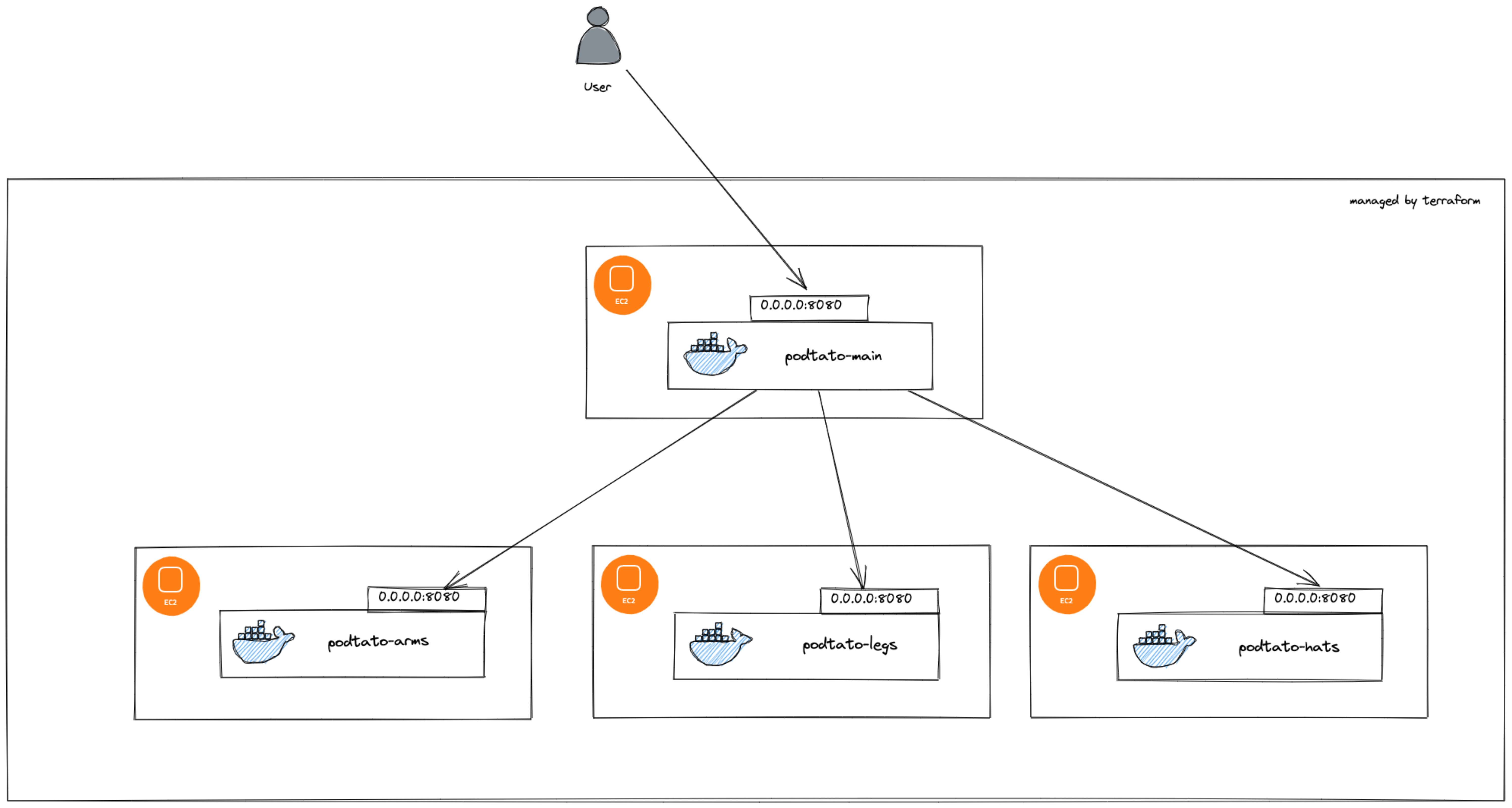
- Modularize a terraform configuration
- Enable Load Balancing and allow the application to scale
- Create a directory called
modulesin your terraform folder (where you created the initial configuration) and change to that directorymkdir modulescd modules
- Add a directory called
podtatoheadthe the modules foldermkdir podtatohead
- Move your initial configuration to the
podtatoheaddirectory - Remove the terraform.tfvars file from the modules/podatohead directory
As we need to ensure that objects can exist multiple times at AWS, we need to change the names of the resulting objects
Firstly, we will introduce a variable, which describes the name of the podtatohead-installation:
modules/podtatohead/vars.tf
#[...]
 variable "podtato_name" {
    type = string
}
#[...]
modules/podtatohead/main.tf
resource "aws_security_group" "ingress-all-ssh" {
  #[...]
  name = "${var.podtato_name}-allow-all-ssh"
  #[...]
}

resource "aws_security_group" "ingress-all-http" {
  #[...]
  name = "${var.podtato_name}-allow-all-http"
  #[...]
}

resource "aws_instance" "podtatohead-arms" {
  #[...]
  tags = {
    Name = "${var.podtato_name}-podtatohead-arms"
  }
  #[...]
}

resource "aws_instance" "podtatohead-legs" {
  #[...]
  tags = {
    Name = "${var.podtato_name}-podtatohead-legs"
  }
  #[...]
}

resource "aws_instance" "podtatohead-hats" {
  #[...]
  tags = {
    Name = "${var.podtato_name}-podtatohead-hats"
  }
  #[...]
}

resource "aws_instance" "podtatohead-main" {
  #[...]
  tags = {
    Name = "${var.podtato_name}-podtatohead-main"
  }
  #[...]
}
We need to create the module configuration in the root of your terraform directory. There, a file called main.tf should be created
main.tf
module "podtatohead-1" {
  source = "./modules/podtatohead"
  podtato_name = "first"
  hats_version = "v3"
  left_arm_version = "v2"
  left_leg_version = "v1"
  podtato_version = "v0.1.0"
  right_arm_version = "v4"
  right_leg_version = "v1"
}
Furthermore, we need to create a provider.tf file with the following contents: provider.tf
provider "aws" {
  region = "us-east-1"
}
- Run terraform init and plan the execution
terraform initterraform plan
Now, that the configuration is modularized, it's an easy exercise to create a second instance. Just add a second module block to main.tf. Feel free to change the versions of the components
main.tf
module "podtatohead-2" {
  source = "./modules/podtatohead"
  podtato_name = "second"
  hats_version = "v1"
  left_arm_version = "v3"
  left_leg_version = "v2"
  podtato_version = "v0.1.0"
  right_arm_version = "v2"
  right_leg_version = "v1"
}
Define the outputs for this module
To get the correct urls for both instances, add the following lines to main.tf
output "first-url" {
  value = module.podtatohead-1.podtato-url
}

output "second-url" {
  value = module.podtatohead-2.podtato-url
}
- Run terraform init and plan the execution
terraform initterraform plan
- Execute the plan
terraform apply
- You should see a similar output as here:
Apply complete! Resources: 12 added, 0 changed, 0 destroyed.

Outputs:

first-url = "http://<ip>:8080"
second-url = "http://<ip>:8080"
- Open the AWS Console, and take a look on EC2 -> Instances
- You should see some instances appearing
- Note that they are prefixed with their
podtato_name
- After some minutes, you are able to browse tot the two URLs specified in the output
At some point in time, our application might get visited and used more often and we might want to add additional instances.
Therefore, we will create:
- Launch Configurations
- Auto Scaling Groups
- Elastic Load Balancers
Have fun in the following chapters ...
At first, we will change the main service to fulfill our new needs.
Therefore, we will create a launch configuration which will act as the template for our created instances. Let's create this in a new file:
modules/podtatohead/main-svc.tf
resource "aws_launch_configuration" "podtatohead-main" {
  image_id = data.aws_ami.amazon-2.image_id
  instance_type = "t3.micro"
  user_data = base64encode(templatefile("${path.module}/templates/init_main.tpl", { container_image = "ghcr.io/fhb-codelabs/podtato-small-main", hats_host = aws_instance.podtatohead-hats.private_ip, arms_host = aws_instance.podtatohead-arms.private_ip, legs_host = aws_instance.podtatohead-legs.private_ip, podtato_version=var.podtato_version } ))
  security_groups = [aws_security_group.ingress-all-ssh.id, aws_security_group.ingress-all-http.id]
  name_prefix = "${var.podtato_name}-podtatohead-main-"

  lifecycle {
    create_before_destroy = true
  }
}
You might notice, that this is mainly the same as an ec2 instance. The only differences are the base64 encoded user_data and the security_group instead of the vpc_security_group_id.
- Remove the aws_instance "podtatohead_main" from your main.tf
- If we would apply this configuration now, the most of the things won't work as we only created an instance template now.
- To get the instances created afterwards, we need at least an auto-scaling group which takes control over the creation/deletion of the instances
modules/podtatohead/main-svc.tf
resource "aws_autoscaling_group" "asg-podtatohead-main" {
  availability_zones = ["${var.region}a", "${var.region}b", "${var.region}c"]
  desired_capacity   = var.desired_instances
  max_size           = var.max_instances
  min_size           = var.min_instances
  name = "${var.podtato_name}-main-asg"

  launch_configuration = aws_launch_configuration.podtatohead-main.name

  health_check_type    = "ELB"
  load_balancers = [
    aws_elb.main_elb.id
  ]

  instance_refresh {
    strategy = "Rolling"
    preferences {
      min_healthy_percentage = 50
      instance_warmup = "60"
    }
    triggers = ["tag"]
  }

  tag {
    key                 = "Name"
    value               = "${var.podtato_name}-podtatohead-main"
    propagate_at_launch = true
  }

}
- As you might have seen in the template, we introduced a few more variables in our configuration. The three variables
desired_instances,max_instancesandmin_instancesare controlling the sizing behaviour. Furthermore, we will define a region to specify where the instances should be created.
modules/podtatohead/vars.tf
variable "region" {
  type = string
  default = "us-east-1"
}

variable "min_instances" {
  type = number
  default = 1
}

variable "max_instances" {
  type = number
  default = 1
}

variable "desired_instances" {
  type = number
  default = 1
}
- Another thing you might have noticed is, that we use some load balancing related things here. Therefore, we`ll also need a load balancer for the auto-scaling group to route the traffic there
modules/podtatohead/main-svc.tf
resource "aws_elb" "main_elb" {
  name = "${var.podtato_name}-main-elb"
  availability_zones = ["${var.region}a", "${var.region}b", "${var.region}c"]
  security_groups = [
    aws_security_group.elb_http.id
  ]

  health_check {
    healthy_threshold = 2
    unhealthy_threshold = 2
    timeout = 3
    interval = 30
    target = "HTTP:8080/"
  }

  listener {
    lb_port = 80
    lb_protocol = "http"
    instance_port = "8080"
    instance_protocol = "http"
  }
}
- This load-balancer also needs a security group to define the allowed traffic to it. Therefore, we'll create this security group in the main configuration file.
modules/podtatohead/main.tf
resource "aws_security_group" "elb_http" {
  name        = "${var.podtato_name}-elb_http"
  description = "Allow HTTP traffic to instances through Elastic Load Balancer"

  ingress {
    from_port   = 80
    to_port     = 80
    protocol    = "tcp"
    cidr_blocks = ["0.0.0.0/0"]
  }

  egress {
    from_port   = 0
    to_port     = 0
    protocol    = "-1"
    cidr_blocks = ["0.0.0.0/0"]
  }

  tags = {
    Name = "Allow HTTP through ELB Security Group"
  }
}
- Finally, we are able to switch the URL of our podtato-head to our new load balancer
modules/podtatohead/outputs.tf
output "podtato-url" {
  value = "http://${aws_elb.main_elb.dns_name}"
}
- Now we could re-apply our terraform-configuration
terraform planterraform apply
- Afterwards, the two podtatohead-installations should be created, and you should see the URLs of the main-service load balancers.
- Now, you could inspect your work on the AWS Console (EC2-Load Balancers)
- Take a look on the instances, and on their state
- It might take some time until the website is reachable
Now, we will change the hats service, the methodology is almost the same, but we should be aware that we need to make changes in the main service too, as this will also use the load balancer for the hats service in the future.
Launch Configuration
modules/podtatohead/hats-svc.tf
resource "aws_launch_configuration" "podtatohead-hats" {
  image_id = data.aws_ami.amazon-2.image_id
  instance_type = "t3.micro"
  user_data = base64encode(templatefile("${path.module}/templates/init_hats.tpl", { container_image = "ghcr.io/fhb-codelabs/podtato-small-hats", podtato_version=var.podtato_version, version=var.hats_version } ))
  security_groups = [aws_security_group.ingress-all-ssh.id, aws_security_group.ingress-all-http.id]
  name_prefix = "${var.podtato_name}-podtatohead-hats-"

  lifecycle {
    create_before_destroy = true
  }
}
- Remove the aws_instance "podtatohead_hats" from your main.tf
Auto Scaling Group
modules/podtatohead/hats-svc.tf
resource "aws_autoscaling_group" "asg-podtatohead-hats" {
  availability_zones = ["${var.region}a", "${var.region}b", "${var.region}c"]
  desired_capacity   = var.desired_instances
  max_size           = var.max_instances
  min_size           = var.min_instances
  name = "${var.podtato_name}-hats-asg"

  launch_configuration = aws_launch_configuration.podtatohead-hats.name


  health_check_type    = "ELB"
  load_balancers = [
    aws_elb.hats_elb.id
  ]
  instance_refresh {
    strategy = "Rolling"
    preferences {
      min_healthy_percentage = 50
    }
    triggers = ["tag"]
  }

  tag {
    key                 = "Name"
    value               = "${var.podtato_name}-podtatohead-hats"
    propagate_at_launch = true
  }

}
Load Balancer
- Another thing you might have noticed is, that we use some load balancing related things here. Therefore, we`ll also need a load balancer for the auto-scaling group to route the traffic there
modules/podtatohead/hats-svc.tf
resource "aws_elb" "hats_elb" {
  name = "${var.podtato_name}-hats-elb"
  availability_zones = ["${var.region}a", "${var.region}b", "${var.region}c"]
  security_groups = [
    aws_security_group.elb_http_8080.id
  ]

  health_check {
    healthy_threshold = 2
    unhealthy_threshold = 2
    timeout = 3
    interval = 30
    target = "HTTP:8080/images/hat-01.svg"
  }

  listener {
    lb_port = 8080
    lb_protocol = "http"
    instance_port = "8080"
    instance_protocol = "http"
  }

}
- This load-balancer also needs a security group to define the allowed traffic to it. Therefore, we'll create this security group in the main configuration file. This is a different security group than we used for the main service.
modules/podtatohead/main.tf
resource "aws_security_group" "elb_http_8080" {
  name        = "${var.podtato_name}-elb_http_8080"
  description = "Allow HTTP traffic to instances through Elastic Load Balancer"

  ingress {
    from_port   = 8080
    to_port     = 8080
    protocol    = "tcp"
    cidr_blocks = ["0.0.0.0/0"]
  }

  egress {
    from_port       = 0
    to_port         = 0
    protocol        = "-1"
    cidr_blocks     = ["0.0.0.0/0"]
  }

  tags = {
    Name = "Allow HTTP through ELB Security Group"
  }
}
- Finally, we are able to switch the hostname in the main service to the new load balancer
modules/podtatohead/main-svc.tf
resource "aws_launch_configuration" "podtatohead-main" {
  #[...]

  user_data = base64encode(templatefile("${path.module}/templates/init_main.tpl", {
    container_image = "ghcr.io/fhb-codelabs/podtato-small-main", hats_host = aws_elb.hats_elb.dns_name,
    arms_host       = aws_instance.podtatohead-arms.private_ip, legs_host = aws_instance.podtatohead-legs.private_ip,
    podtato_version = var.podtato_version
  } ))
  #[...]
}
- Now we could re-apply our terraform-configuration
terraform planterraform apply
- Afterwards, the podtatohead-installations should get updated to remove the single instances of the hats-service, replace them with the auto scaling groups and create the load balancers. After some time, the installation should work again.
Now, we will change the legs service, the methodology is almost the same, but we should be aware that we need to make changes in the main service too, as this will also use the load balancer for the hats service in the future.
Launch Configuration
modules/podtatohead/legs-svc.tf
resource "aws_launch_configuration" "podtatohead-legs" {
  image_id = data.aws_ami.amazon-2.image_id
  instance_type = "t3.micro"
  user_data = base64encode(templatefile("${path.module}/templates/init.tpl", { container_image = "ghcr.io/fhb-codelabs/podtato-small-legs", podtato_version=var.podtato_version, left_version=var.left_leg_version, right_version=var.right_leg_version} ))
  security_groups = [aws_security_group.ingress-all-ssh.id, aws_security_group.ingress-all-http.id]
  name_prefix = "${var.podtato_name}-podtatohead-legs-"

  lifecycle {
    create_before_destroy = true
  }
}
- Remove the aws_instance "podtatohead_legs" from your main.tf
Auto Scaling Group
modules/podtatohead/legs-svc.tf
resource "aws_autoscaling_group" "asg-podtatohead-legs" {
  availability_zones = ["${var.region}a", "${var.region}b", "${var.region}c"]
  desired_capacity   = var.desired_instances
  max_size           = var.max_instances
  min_size           = var.min_instances
  name = "${var.podtato_name}-legs-asg"

  launch_configuration = aws_launch_configuration.podtatohead-legs.name

  health_check_type    = "ELB"
  load_balancers = [
    aws_elb.legs_elb.id
  ]

  instance_refresh {
    strategy = "Rolling"
    preferences {
      min_healthy_percentage = 50
    }
    triggers = ["tag"]
  }

  tag {
    key                 = "Name"
    value               = "${var.podtato_name}-podtatohead-legs"
    propagate_at_launch = true
  }
}
Load Balancer
- Another thing you might have noticed is, that we use some load balancing related things here. Therefore, we`ll also need a load balancer for the auto-scaling group to route the traffic there
modules/podtatohead/legs-svc.tf
resource "aws_elb" "legs_elb" {
  name = "${var.podtato_name}-legs-elb"
  availability_zones = ["${var.region}a", "${var.region}b", "${var.region}c"]
  security_groups = [
    aws_security_group.elb_http_8080.id
  ]

  health_check {
    healthy_threshold = 2
    unhealthy_threshold = 2
    timeout = 3
    interval = 30
    target = "HTTP:8080/images/left-leg-01.svg"
  }

  listener {
    lb_port = 8080
    lb_protocol = "http"
    instance_port = "8080"
    instance_protocol = "http"
  }

}
- Finally, we are able to switch the hostname in the main service to the new load balancer
modules/podtatohead/main-svc.tf
resource "aws_launch_configuration" "podtatohead-main" {
  #[...]

  user_data = base64encode(templatefile("${path.module}/templates/init_main.tpl", {
    container_image = "ghcr.io/fhb-codelabs/podtato-small-main", hats_host = aws_elb.hats_elb.dns_name,
    arms_host       = aws_instance.podtatohead-arms.private_ip, legs_host = aws_elb.legs_elb.dns_name,
    podtato_version = var.podtato_version
  } ))
  #[...]
}
- Now we could re-apply our terraform-configuration
terraform planterraform apply
- Afterwards, the podtatohead-installations should get updated to remove the single instances of the legs-service, replace them with the auto scaling groups and create the load balancers. After some time, the installation should work again.
Finally, we will change the arms service, the methodology is almost the same, but we should be aware that we need to make changes in the main service too, as this will also use the load balancer for the hats service in the future.
Launch Configuration
modules/podtatohead/arms-svc.tf
resource "aws_launch_configuration" "podtatohead-arms" {
  image_id = data.aws_ami.amazon-2.image_id
  instance_type = "t3.micro"
  user_data = base64encode(templatefile("${path.module}/templates/init.tpl", { container_image = "ghcr.io/fhb-codelabs/podtato-small-arms", podtato_version=var.podtato_version, left_version=var.left_arm_version, right_version=var.right_arm_version} ))
  security_groups = [aws_security_group.ingress-all-ssh.id, aws_security_group.ingress-all-http.id]
  name_prefix = "${var.podtato_name}-podtatohead-arms-"

  lifecycle {
    create_before_destroy = true
  }

}
- Remove the aws_instance "podtatohead_arms" from your main.tf
Auto Scaling Group
modules/podtatohead/arms-svc.tf
resource "aws_autoscaling_group" "asg-podtatohead-arms" {
  availability_zones = ["${var.region}a", "${var.region}b", "${var.region}c"]
  desired_capacity   = var.desired_instances
  max_size           = var.max_instances
  min_size           = var.min_instances
  name = "${var.podtato_name}-arms-asg"

  launch_configuration = aws_launch_configuration.podtatohead-arms.name


  health_check_type    = "ELB"
  load_balancers = [
    aws_elb.arms_elb.id
  ]

  instance_refresh {
    strategy = "Rolling"
    preferences {
      min_healthy_percentage = 50
    }
    triggers = ["tag"]
  }
  tag {
    key                 = "Name"
    value               = "${var.podtato_name}-podtatohead-arms"
    propagate_at_launch = true
  }
}
Load Balancer
- Another thing you might have noticed is, that we use some load balancing related things here. Therefore, we`ll also need a load balancer for the auto-scaling group to route the traffic there
modules/podtatohead/arms-svc.tf
resource "aws_elb" "arms_elb" {
  name = "${var.podtato_name}-arms-elb"
  availability_zones = ["${var.region}a", "${var.region}b", "${var.region}c"]
  security_groups = [
    aws_security_group.elb_http_8080.id
  ]

  health_check {
    healthy_threshold = 2
    unhealthy_threshold = 2
    timeout = 3
    interval = 30
    target = "HTTP:8080/images/left-arm-01.svg"
  }

  listener {
    lb_port = 8080
    lb_protocol = "http"
    instance_port = "8080"
    instance_protocol = "http"
  }

}
- Finally, we are able to switch the hostname in the main service to the new load balancer
modules/podtatohead/main-svc.tf
resource "aws_launch_configuration" "podtatohead-main" {
  image_id = data.aws_ami.amazon-2.image_id
  instance_type = "t3.micro"
  user_data = base64encode(templatefile("${path.module}/templates/init_main.tpl", { container_image = "ghcr.io/fhb-codelabs/podtato-small-main", hats_host = aws_elb.hats_elb.dns_name, arms_host = aws_elb.arms_elb.dns_name, legs_host = aws_elb.legs_elb.dns_name, podtato_version=var.podtato_version } ))
  security_groups = [aws_security_group.ingress-all-ssh.id, aws_security_group.ingress-all-http.id]
  name_prefix = "${var.podtato_name}-podtatohead-main-"

  lifecycle {
    create_before_destroy = true
  }
}
- Now we could re-apply our terraform-configuration
terraform planterraform apply
- Afterwards, the podtatohead-installations should get updated to remove the single instances of the arms-service, replace them with the auto scaling groups and create the load balancers. After some time, the installation should work again.
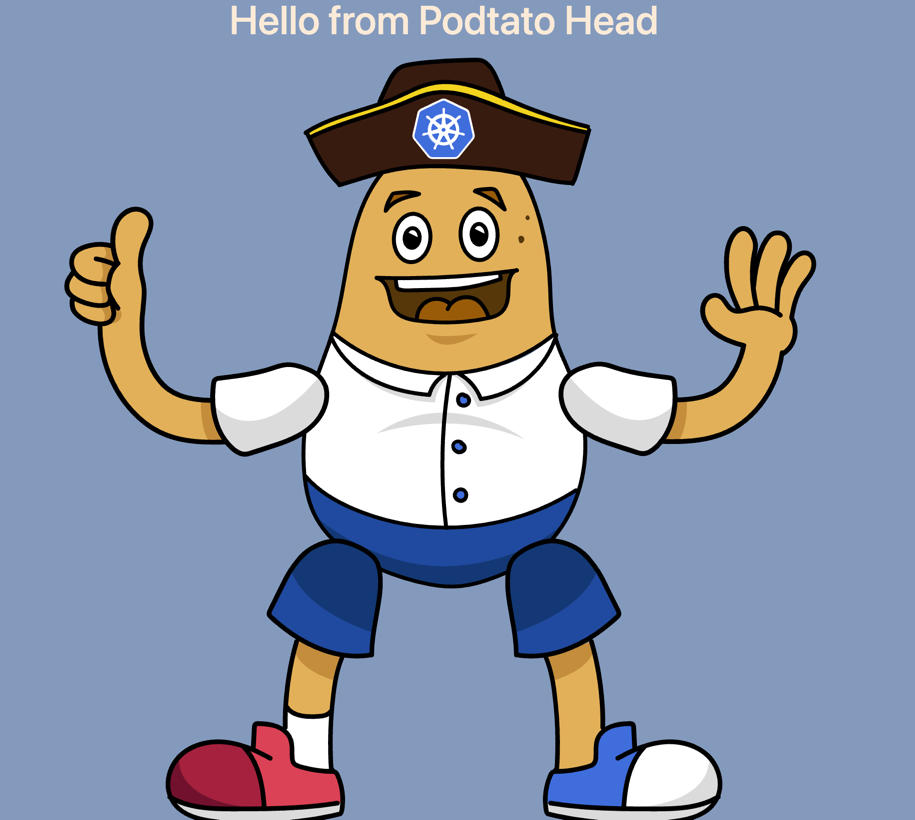
- Now you can play around, change versions of the components and scale them up and down
- If you want you can make the components scale individually
- Note, that you will face service outages when you have less than one instance running